
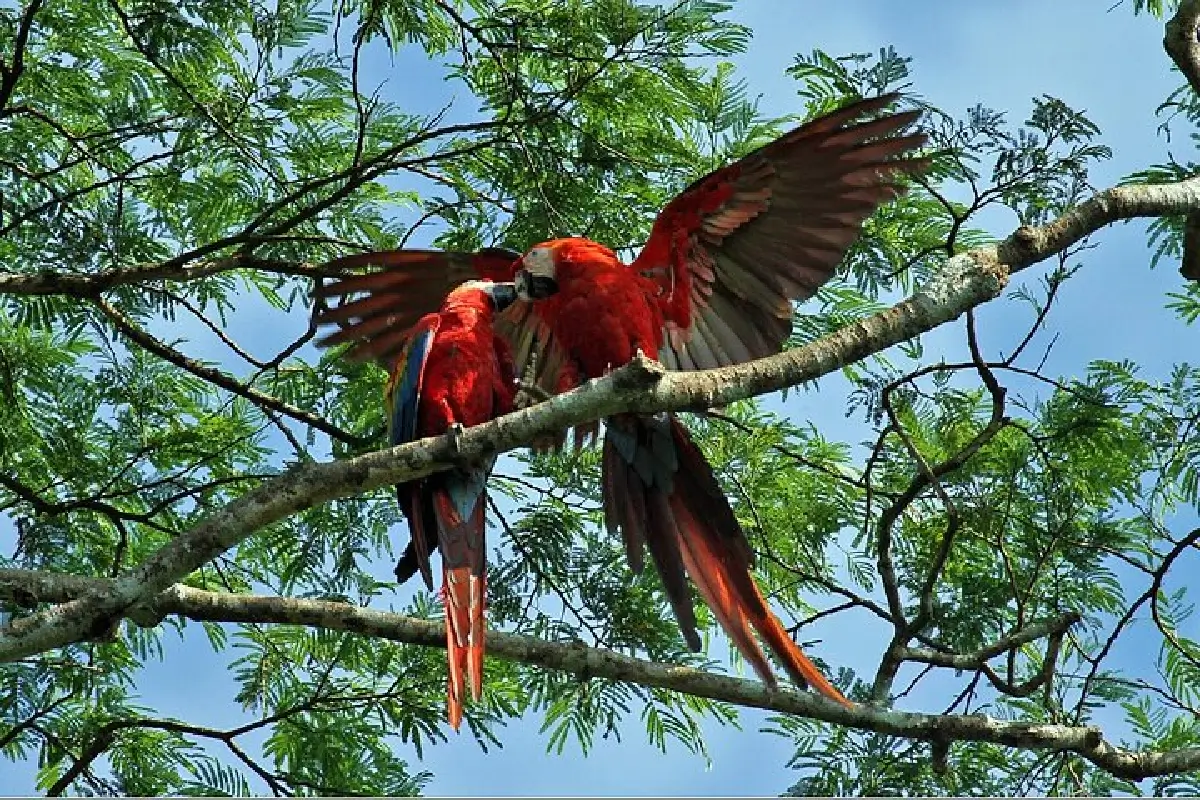
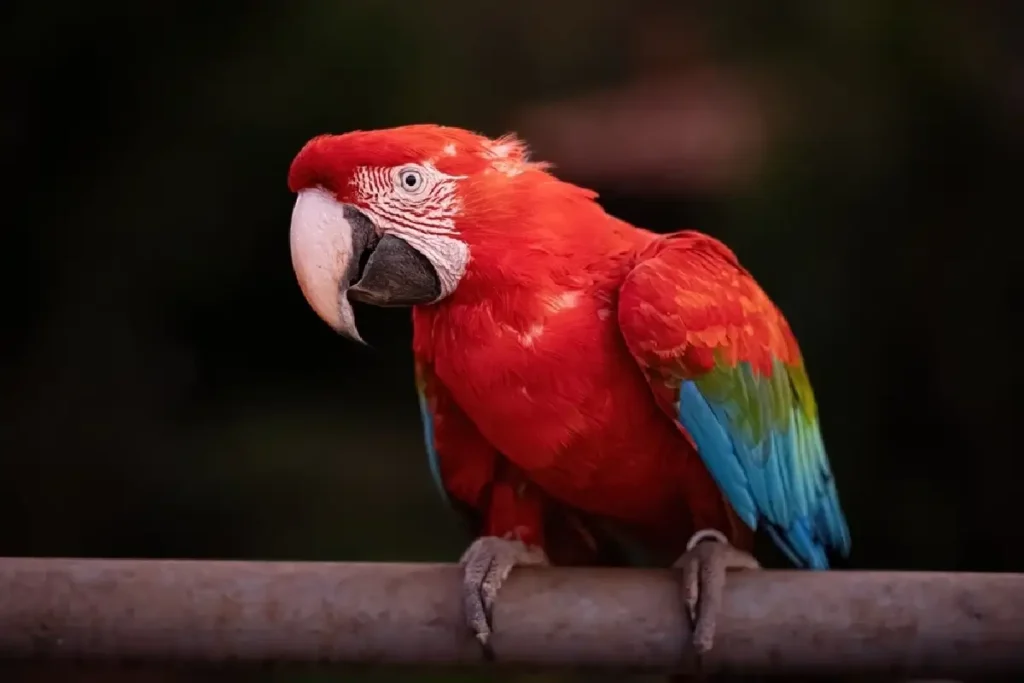
The red-and-green macaw is a giant Amazonian bird recognized for its bright plumage and striking wings. These birds live high in the rainforest canopy and usually travel in noisy groups. Observing macaws in the wild, such as in the Tambopata Reserve (Peru), is an unforgettable experience.
Red-and-green Macaw in Tambopata
The Tambopata National Reserve (Madre de Dios, Peru) protects 274,690 hectares of Amazon rainforest and is home to more than 1,300 bird species (10% of all the birds in the world). Among them, the red-and-green macaws stand out. Every morning, the clay licks or clay licks of Tambopata (such as Chuncho and Colorado) attract enormous flocks of scarlet and green-winged macaws. From the opposite shore of these clay cliffs, visitors can observe how dozens or hundreds of macaws arrive to feed and drink minerals from the clay lick walls. The abundance of these macaws in Tambopata has inspired scientific projects such as the Tambopata Macaw Project, dedicated to studying their ecology and protecting their habitats.
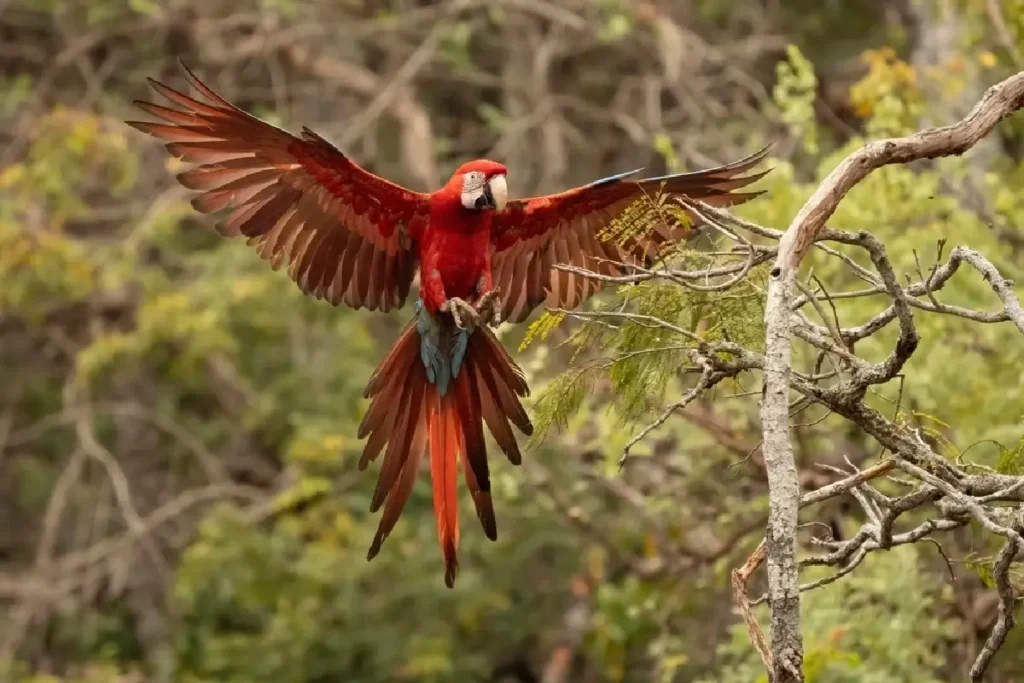
Habitat of the Red-and-green Macaw
These macaws mainly inhabit lowland tropical rainforests, especially near rivers and streams. They occupy altitudes ranging from sea level to nearly 1,000 meters. Their habitat also includes riverside savannas and open shrublands adjacent to the forest. In general, they spend most of the day perched or flying in the treetops, since that is where they find their favorite fruits and seeds. They rarely descend to the ground, which keeps them safer from predators.
Characteristics of the Red-and-green Macaw
- Scientific name: Ara macao (scarlet macaw) and Ara chloropterus (green-winged macaw).
- Other common names: tricolor macaw, South American red macaw, parrot, red-and-green parrot, among others.
- Habitat: tropical humid forests and jungles of the Amazon; the scarlet macaw also lives in small populations in Costa Rica and Panama, while the green-winged macaw is distributed throughout South America.
- Altitudinal range: up to 400–500 meters above sea level in the Peruvian Amazon (in some areas they reach close to 1,000 m).
- Dimensions: the scarlet macaw measures approximately 84 – 91 cm, including the tail, which can measure up to 53 cm. In the case of the red-and-green macaw, its length varies between 89 – 97 cm, making it larger than the scarlet macaw.
- Weight: around 1 kilogram on average (it may vary slightly depending on the species).
- Diet: herbivorous diet that includes fruits, seeds, and nuts, and they supplement minerals by drinking sodium-rich clay at the clay licks.
- Incubation period: about 3 to 4 weeks (around 25 days on average). During the breeding season they usually lay 2 or 3 white eggs in a tree cavity.
- Lifespan: they typically live between 30 and 50 years in the wild (in captivity they can exceed 75 years, although they rarely survive that long in nature).
- Flock life: they are highly social diurnal birds. They form large flocks (sometimes dozens) to feed and travel together. While flying, they emit loud and striking squawks that can be heard from a great distance.
- Mates for life: red-and-green macaws usually mate for life. They maintain strong pair bonds and raise their young together year after year.
- Nests in tall trees: they nest in natural cavities of giant trees (such as the shihuahuaco), taking advantage of hollows that take centuries to form. This makes them vulnerable if those trees are cut down.
- Clay drinkers: they have the curious habit of ingesting mineral clay from the clay licks. This behavior helps neutralize toxins from certain foods and provides essential minerals.
- Juveniles and chicks: the female incubates the eggs for about 25 to 28 days, and the chicks remain in the nest for approximately 90 days before flying. They then become independent at around one year of age.
- Language and learning: they are skilled imitators of sounds. Although very noisy in the wild, they can imitate words in captivity.
- Left-hand dominant: like many parrots, they tend to use their left claw to hold food while eating.
- Longevity: they can live half a century or more in the wild, which is remarkable for birds of their size.
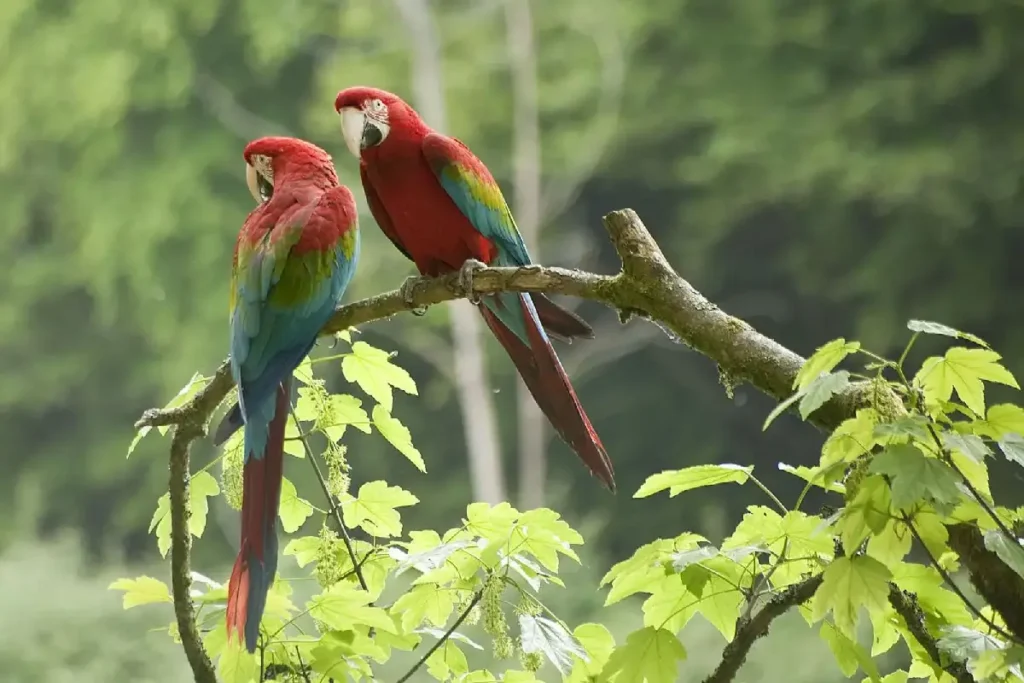
Where to See Red-and-green Macaws in the Wild?
The Tambopata Reserve (Peru) is one of the most famous places to spot both macaws. At the main lodges and tours, dawn excursions are organized to the viewpoints of the Chuncho and Colorado clay licks, where flocks of scarlet and green-winged macaws arrive every morning to feed. Outside Peru, these species also inhabit other Latin American rainforests: Ara macao and Ara chloropterus are found from Central America (Costa Rica, Panama) to the Amazon lowlands of Brazil, Colombia, Ecuador, Bolivia, and Paraguay. However, Tambopata stands out for its exceptional concentration of macaws and the ease of guided observation.
Behavior and Fun Facts About the Red-and-green Macaw
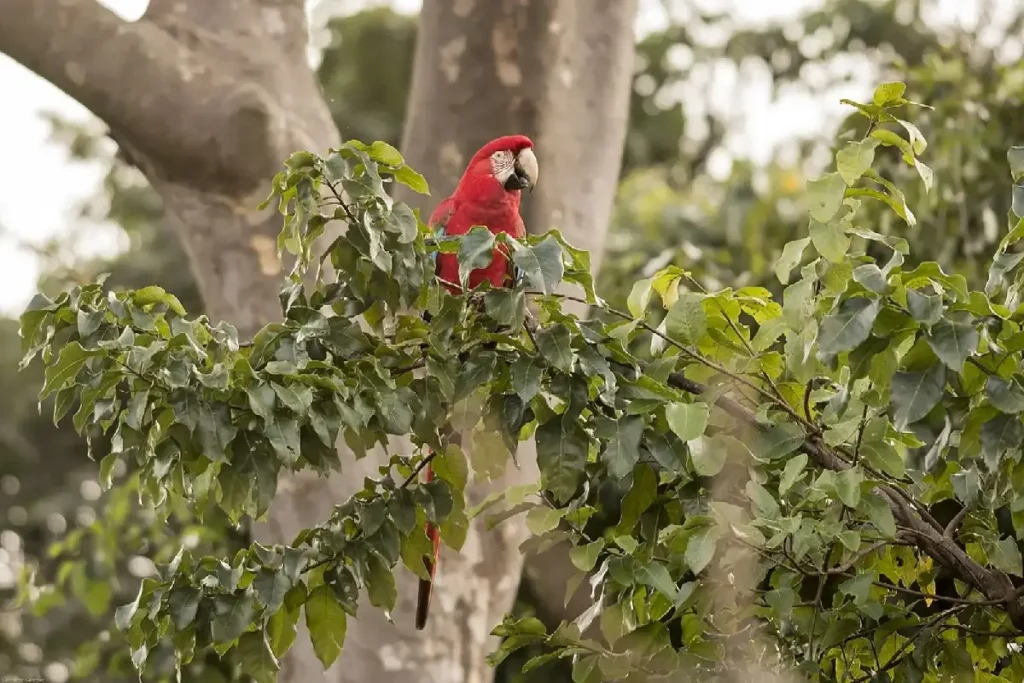
Red-and-green Macaw Watching Tours in Tambopata
To experience macaw watching, it is advisable to book a guided tour that includes river transportation to the Tambopata clay licks. Tours begin very early: guides take visitors to designated viewpoints before sunrise to wait for the arrival of the macaws. In this way, it is possible to observe the spectacular descent of hundreds of macaws toward the clay walls. Several lodges and agencies in Madre de Dios offer 2- to 4-day packages that include these excursions, jungle lodging, and local meals. Although we do not provide prices, everyone highlights that the experience is worth it: many travelers describe witnessing this natural spectacle as the “highlight” of their trip. In addition, choosing a tour with responsible operators contributes to conservation: for example, part of the profits support the Tambopata Macaw Project, a program dedicated to protecting these macaws. In summary, exploring Tambopata with our expert guides guarantees maximizing the opportunity to see red-and-green macaws in the wild, turning the excursion into an unforgettable and educational adventure.
Discover the red-and-green macaw photography tour in the Tambopata Reserve, one of the best destinations in the Peruvian Amazon. Experience the unique spectacle of the clay licks and observe these impressive birds in the wild. Book with us and enjoy an unforgettable adventure in Tambopata.